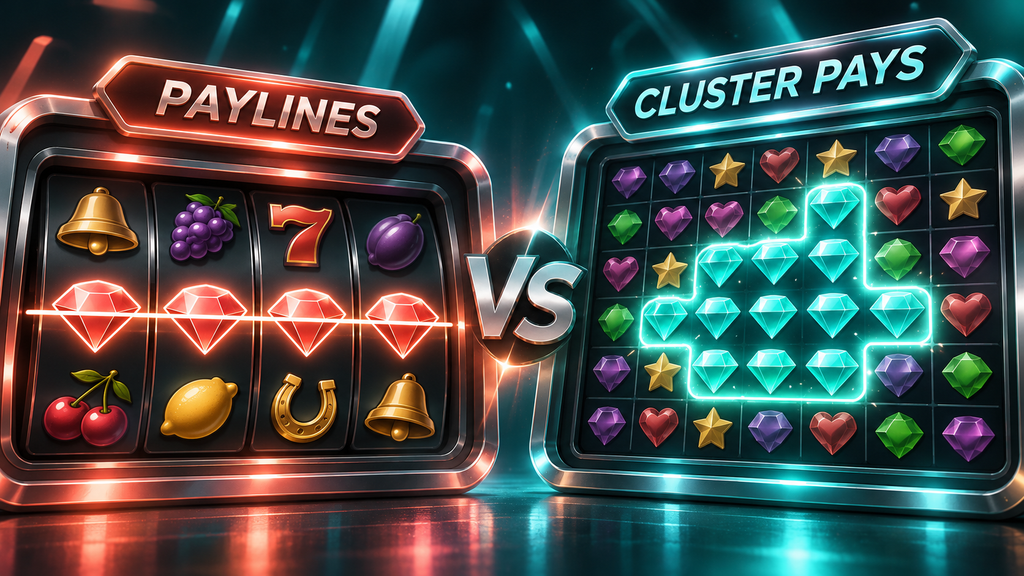
Two mechanics, two different ideas of what a win looks like. Payline pokies pay when matching symbols land in a fixed sequence across a set number of lines. Cluster pays titles pay when a group of matching symbols, usually five or more, connects on the grid. For Australian players choosing where to play, bonus offers at Bao Casino cover both game types under the same 35x wagering terms. The distinction between the two runs deeper than layout: different volatility profiles, different bonus structures and different ceilings for what a single spin can return.
How Payline Mechanics Work
A payline title has a fixed number of win lines, between 10 and 50 on most titles, though some run up to 1,024 ways or more through an all-ways mechanic. A win forms when matching symbols land in adjacent positions from left to right across an active payline.
The fixed structure makes win conditions predictable. A player can read the paytable and know exactly which symbol combinations pay, on which lines, and at what multiple of the bet. That transparency is part of the format’s appeal.
Volatility on payline titles runs the full range. A low-volatility configuration triggers wins frequently with modest returns. Push that up to high volatility and the wins thin out but carry more weight when they land. The left-to-right sequence mechanic itself does not push the title toward either end.
How Cluster Pays Mechanics Work
Cluster pays titles replace paylines with a grid, usually 7×7 or 8×8, where winning requires a group of five or more identical symbols to connect horizontally or vertically. The larger the cluster, the higher the payout multiple.
A single spin can produce multiple separate clusters simultaneously. Each pays independently, and because clusters of different sizes on the same spin carry different multiples, the relationship between spin result and total payout is more variable than on a fixed payline title.
Most cluster pays titles pair the core mechanic with cascades: winning symbols are removed and new ones fall into their positions, potentially forming additional clusters from the same spin. Each cascade is a separate win event within the same paid spin. A cascade chain of four or five events from one starting cluster can produce a combined return significantly above what any individual cluster win would suggest.
Volatility Comparison
Cluster pays titles carry higher average volatility than payline titles, driven by the cascade mechanic. A grid that kicks off a cascade chain can produce substantial returns from a single spin. One that produces no initial cluster returns nothing.
A rough comparison:
| Format | Typical volatility range | Bonus trigger frequency | Max win potential |
| Standard payline (10–50 lines) | Low to medium | 1 in 50–150 spins | 500x–5,000x stake |
| All-ways payline (1,024+ ways) | Medium to high | 1 in 100–200 spins | 2,000x–10,000x stake |
| Cluster pays (7×7 or 8×8 grid) | High to very high | 1 in 150–300 spins | 5,000x–50,000x stake |
These are ranges across the category, not guarantees for any individual title. High volatility in a cluster pays title means longer dry spells between meaningful base game returns and concentrated value inside the bonus round.
Bonus Round Structure
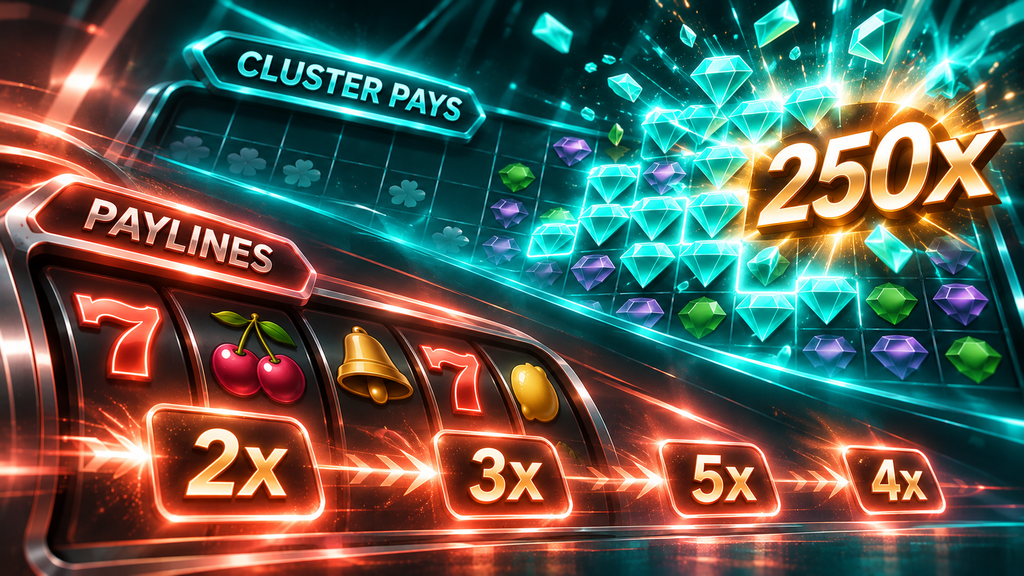
The bonus round in a cluster pays title is where the format’s big win potential concentrates. Free spins on a cluster pays grid with an incrementing multiplier produce a different distribution of outcomes from a standard payline free spins round.
A typical cluster pays bonus round runs 10 to 15 free spins with a multiplier that increments by 1x per cascade, uncapped or capped at 15x to 100x depending on the title. A cascade chain of ten events on spin seven of a free spins round with a 7x starting multiplier produces wins at 7x, 8x, 9x through to 16x on each cascade. The final cascades carry most of the spin’s total value.
Payline bonus rounds tend to deliver more consistent returns. Each spin pays at the base multiplier, and variance comes from which symbol combinations land, not from a multiplier compounding across the round. More predictable. Less swing.
Win Size Distribution
The practical difference between the two formats shows in how wins are distributed across sessions.
Payline session returns tend to cluster around the mid-range. Very high wins are possible but require specific high-value symbol combinations across multiple lines simultaneously. The base game sustains a portion of the balance through regular small wins on a low-volatility configuration.
Cluster pays sessions look different. The base game can run 30 to 50 spins without a cluster forming across the full grid. When a cascade chain lands, the return from that one spin can equal or exceed several times the preceding cost. Binary is the right word: a small number of large events surrounded by stretches of minimal return.
Stake and Session Budget Implications
Cluster pays titles demand more session runway than payline titles at the same stake, because the base game between bonus triggers produces fewer return events. A player comfortable with 150 spins on a payline title should budget for 200 to 300 spins on a cluster pays title at the same stake to reach a comparable number of bonus rounds.
The buy feature is more commonly used on cluster pays titles, partly because the base game between bonuses runs lean and partly because the bonus round’s multiplier mechanic is where the format’s most distinctive outcomes live. At 100x to 200x stake, buying the bonus directly on a cluster pays title is a common approach for Australian players who want to access the round without grinding through the base game.

Which Format for Bonus Wagering
Payline titles are the more practical choice for clearing a wagering requirement. Frequent base game wins on a low-volatility payline title extend the balance and provide steady wagering progress, drawing down slowly across many spins.
Cluster pays titles exhaust a bonus balance faster during base game stretches. The high variance inside the bonus round makes the clearing path less predictable. For Australian players activating a 35x deposit bonus and planning to clear it through regular play, low to medium volatility payline titles are the more efficient route.
FAQ
Which format gives Australian players a better chance of a large single win?
Cluster pays titles carry higher maximum win potential and more variable single-spin outcomes, driven by cascade multiplier mechanics. The largest single wins in the format, some reaching 20,000x to 50,000x stake, occur through sustained cascade chains during the bonus round with an uncapped or high-ceiling multiplier.
Do cluster pays titles pay out less frequently than payline titles?
In the base game, yes. Cluster pays titles require a group of five or more matching symbols to connect on the grid before any payout occurs. Payline titles pay on shorter matching sequences, producing wins more frequently. The tradeoff is that cluster pays wins, when they land, tend to be larger.
Can cluster pays titles be played during a bonus wagering period?
Most Australian casino platforms include cluster pays titles in bonus wagering contribution at 100%. Check the platform’s excluded titles list, as some specific high-volatility titles may carry restrictions. The game contribution table in the bonus terms confirms which titles qualify.
What stake is recommended for cluster pays titles at Australian casinos?
Starting at a lower stake than on a comparable payline title gives more spins to reach a bonus trigger, which is where the format’s potential concentrates. A player who runs $1 per spin on a payline title might consider $0.50 to $0.75 on a cluster pays title of similar volatility to maintain comparable session duration.
Is the buy feature worth using on cluster pays titles?
On high-volatility cluster pays titles, the base game between bonus triggers can cost more in expected wagers than the buy feature price. At 100x to 150x stake, buying the bonus directly may cost less than the expected base game path to the round on a very high volatility title. The title’s paytable and bonus frequency figure confirm whether the calculation holds for that specific game.